

So you want to learn Danish – but you’re not sure where to start, which course is worth your time, or how hard it actually is. This guide gives you a clear overview: the best courses and apps by level, what to expect from the language itself, and how to build a learning routine that actually works. ✓
Danish is spoken by around 6 million people and is the official language of Denmark. It’s also widely understood across Scandinavia – meaning solid Danish gives you a foothold in Norway and Sweden too. Whether you’re learning for work, travel, family, or pure curiosity, the right starting point makes a significant difference in how fast you progress.
From my own experience learning Danish systematically – starting from zero, building vocabulary methodically, and eventually reaching conversational fluency – I know that the biggest obstacle isn’t the language itself. It’s choosing the wrong method for your learning style and then running out of steam.
This guide cuts through the noise.
Quick Answer: How to Learn Danish – By Goal
- Complete beginner: Start with a structured vocabulary course (17 Minute Languages or Babbel) + pronunciation practice from day one
- Already have basics (A2): Move to an intermediate course focused on real dialogue and listening
- Need it for work: Combine a course with a tutor on Preply for professional conversation practice
- Travelling soon: Focus on the most common Danish phrases + numbers first
- Long-term fluency goal: Systematic vocabulary build + immersion (podcasts, TV series, native speakers)
[ez-toc]
How Hard Is Danish to Learn?
For English speakers, Danish is officially classified as a Category I language by the US Foreign Service Institute – the same category as French, Spanish and Dutch. The estimate is around 575–600 hours to reach professional working proficiency. That’s encouraging compared to languages like Arabic or Mandarin (2,200+ hours).
In practice, the grammar is manageable: two genders instead of three, relatively simple verb conjugation (no person-specific endings), and word order that feels fairly intuitive to English speakers. The vocabulary has significant overlap with English and German through shared Germanic roots.
The real challenge is pronunciation. Danish has a notoriously swallowed, mumbled quality – native speakers drop consonants, compress syllables, and use a glottal catch called the stød that exists in almost no other language. Reading Danish is significantly easier than understanding spoken Danish. This is not a reason to avoid the language – it’s a reason to start listening from day one, not after you feel “ready.”
The number system is another genuine hurdle. Danish numbers above 50 follow a vigesimal (base-20) system that looks completely opaque at first. Once you understand the logic, it clicks – but it takes a dedicated explanation, not just a word list.

Danish Courses by Level: What to Use When
Beginner (A1–A2): Building the Foundation
At beginner level, the most important thing is systematic vocabulary acquisition combined with early pronunciation exposure. Courses that dump grammar rules at you before you have any vocabulary base tend to kill motivation fast. The approach I’ve seen work consistently – and used myself – is spaced repetition vocabulary learning in short daily sessions, right from the start.
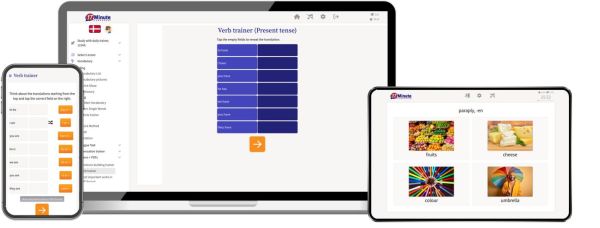
Vocabulary-focused, spaced repetition, native speaker audio. Around 1,300 core words in roughly 3 months at 15–20 minutes per day. Multiple exercise types (multiple choice, writing, listening). Free 2-day demo available – no payment details required.Start free Danish demo →

Babbel Danish is a solid alternative if you prefer more conversational framing from the start. The lessons are shorter and more dialogue-based, which works well for learners who find pure vocabulary drilling demotivating. See the full breakdown: Learn Danish with Babbel.
Intermediate (B1–B2): Going Beyond the Basics
The intermediate level is where most learners plateau. You know enough to get by but not enough to feel comfortable in real conversations. The fix is deliberate exposure to more complex dialogue, a broader vocabulary base (especially around work, relationships, and current events), and more listening to natural speech.
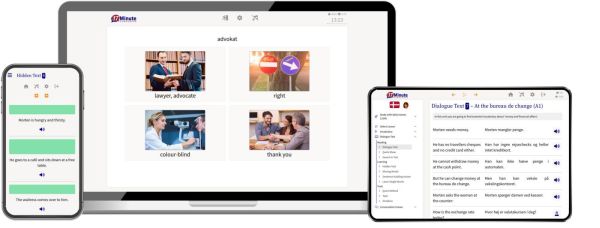
Over 1,800 new words beyond the beginner course, authentic dialogue texts, native speaker audio, flexible audio trainer for on-the-go learning. 31-day money-back guarantee.View intermediate Danish course →
At B1–B2 level, pairing a structured course with a tutor makes a real difference. Speaking with a native speaker forces you to activate vocabulary you’d otherwise only recognize passively. Preply has Danish tutors available for one-on-one sessions at flexible times and prices.
Advanced (C1–C2): Precision and Fluency
At advanced level the game changes: you need less structured input and more authentic immersion. Danish podcasts, TV series with Danish subtitles (not English), reading Danish news, and regular conversation with native speakers all matter more than any course at this stage.
For structured vocabulary expansion at C1/C2, 17 Minute Languages also offers a proficiency-level Danish course with 2,100 additional specialist vocabulary items.
View C1/C2 Danish proficiency course →
Danish Course Comparison: Online vs. Traditional
| Criteria | Online Course | Community College | Private Tutor |
|---|---|---|---|
| Flexibility | ★★★★★ | ★ | ★★★ |
| Cost | Low | Medium | High |
| Pace | Your own | Fixed | Your own |
| Speaking practice | Limited | Yes | Yes – best option |
| Access anywhere | Yes | No | Partly |
| Best for | Self-starters, busy schedules | Structure lovers | Fast results, speaking focus |
Best Apps to Learn Danish
Apps work best as a complement to a structured course, not as a replacement. That said, the right app can make the difference between a learning routine that survives your daily schedule and one that doesn’t.
The two apps I’ve looked at most closely for Danish are Babbel and Mondly. Both have genuine strengths – and both have real limitations that most reviews gloss over.
- Babbel Danish: Strong grammar integration, dialogue-based lessons, good for learners who want to understand why things work, not just memorize. Best for beginners to intermediate. → Full Babbel Danish review | Try Babbel Danish
- Mondly Danish: Gamified, good pronunciation feedback via speech recognition, works well for short daily sessions. Better for motivation maintenance than deep learning. → Full Mondly Danish review | Try Mondly
A detailed side-by-side comparison of Danish learning apps – including Babbel, Mondly and 17 Minute Languages – can be found here: Best apps to learn Danish – tested and compared.
How to Build a Danish Learning Routine That Sticks
The most common mistake is trying to find a perfect two-hour daily window. It doesn’t exist, and waiting for it kills progress. What actually works – and what I’ve seen hold up across learning multiple languages – is a consistent short session that happens regardless of how busy the day is.
A realistic beginner routine that produces measurable results:
- 15–20 minutes daily vocabulary (spaced repetition): Non-negotiable. This is the engine. Miss two days and the system loses its compounding effect.
- 10 minutes listening: Danish radio, a short podcast, or a TV episode with Danish subtitles. Even if you understand almost nothing at first, your ear is adapting.
- Once a week: A short conversation with a tutor or language exchange partner. Speaking activates vocabulary you only half-know and forces you to actually produce the language.
The key insight from my own experience: pronunciation needs to start early, not later. Danish pronunciation does not fix itself passively. If you spend three months only reading and writing, you’ll have to unlearn a lot of habits before you can communicate with native speakers.

Danish Essentials: What to Learn First
If you’re at the very beginning, prioritize in this order:
- Core vocabulary (first 500 words): These cover the vast majority of everyday conversation. A systematic course handles this automatically.
- Numbers: You’ll need them immediately for prices, times, addresses. Danish numbers above 50 require a specific explanation – a bare word list won’t help. → Danish numbers explained (1–100 and beyond)
- Everyday phrases: Greetings, basic questions, polite expressions. → Most common Danish phrases
- Irregular verbs: The most common Danish verbs are irregular – meaning they don’t follow the standard conjugation rules. Learning them early prevents bad habits from forming. → Danish irregular verbs – complete table and how to learn them
- Pronunciation basics: The soft D, the stød, and vowel sounds. Use Forvo or a tutor – don’t guess from spelling.
Start learning Danish today – free of charge
- 2-day free trial – no credit card required
- 15–20 minutes per day – A2 level in around 3 months
- All devices – PC, tablet, smartphone
- Native speaker audio throughout
Everything on Danish – All Resources at a Glance
- 📚 Danish numbers explained – 1 to 100 and beyond
- 💬 Most common Danish phrases for everyday life
- 📱 Learn Danish with Babbel – full review
- 📱 Learn Danish with Mondly – full review
- 📋 Danish irregular verbs – complete conjugation table
- 🔤 How to learn vocabulary successfully
- 💡 How to stay motivated while learning a language
Danish courses in other languages:
About the Author – Sven Mancini
I learned Danish as my second Scandinavian language, after reaching business fluency in Norwegian through systematic self-study. The approach I used – structured vocabulary acquisition, early pronunciation work, and consistent daily sessions – is the same method I later documented in my language learning books. I’ve applied it across five languages and it keeps working.
On Learn-A-New-Language.eu I review and compare language courses based on hands-on testing, not marketing material. Affiliate links on this site are marked with *. My recommendations are based on what actually works – not on commission rates.