Greek has a reputation for being difficult. A different alphabet, complex grammar, no obvious connection to Germanic or Romance languages. That reputation is not entirely wrong – but it is exaggerated. I’ve learned five languages from scratch as an adult, and Greek follows the same pattern I’ve seen every time: the first two to four weeks feel steep, then something clicks.
This guide covers everything you actually need to decide how to learn Greek: which methods work, which courses are worth your money, how long it realistically takes, and what a practical daily routine looks like. No padding, no false promises.
Quick answer: How do you learn Greek effectively?
- Start with the alphabet – it takes 1–2 weeks and unlocks everything else
- Use a structured course for vocabulary and grammar (15–20 min/day)
- Add listening practice from week 3 onwards
- Find a conversation partner once you hit A2
- Realistic timeline: A2 in 3–4 months, B1 in 6–10 months at 20 min/day
Is Greek Hard to Learn?
The honest answer: harder than Spanish, easier than Arabic. The Foreign Service Institute classifies Modern Greek as a Category III language for English speakers – roughly 750–900 classroom hours to reach professional working proficiency. That sounds like a lot. In practice, at 20 minutes a day, that’s 2–3 years to full fluency. But conversational ability – enough to travel, connect with Greek-speaking friends or family, or understand TV with subtitles – comes much earlier.
What makes Greek genuinely challenging:
- The alphabet. 24 letters, none of which you already know. This is the real barrier for the first two weeks. After that it fades completely.
- Grammar complexity. Three genders, four cases, and a verb system that takes time to internalize. Not impossible, but it demands patience.
- Limited transfer from English. Unlike French or Spanish, most Greek vocabulary won’t feel familiar at first – though scientific and academic terms are often Greek-derived, which helps more than you’d expect.
What makes Greek more manageable than its reputation suggests:
- Consistent pronunciation. Once you know the alphabet, Greek is almost entirely phonetic. You read what you see. No silent letters, no pronunciation exceptions to memorize.
- Root patterns. Greek has logical word-building. Once you know a root, related words follow a pattern.
- Motivated native speakers. Greeks genuinely appreciate when foreigners make the effort. That matters more than people realize – real conversations push your progress faster than any app.

The Greek Alphabet: Your First Priority
Every method I’ve seen that skips the alphabet and uses transliteration (writing Greek sounds in Latin letters) creates problems later. You end up dependent on a crutch that native materials don’t use, and relearning takes longer than learning it right the first time.
The alphabet has 24 letters. Spend 10–15 minutes a day for two weeks writing them, recognizing them, and sounding them out. By week three you’ll read Greek street signs without thinking. That moment – when the characters stop looking foreign – is one of the most satisfying early milestones in language learning.
A practical approach: learn the letters in groups by visual similarity to Latin characters first (Α, Ε, Ι, Κ, Μ, Ν, Ο, Τ, Ζ), then tackle the ones that look different. Use a good course that integrates alphabet training from day one rather than treating it as a separate module.
The Best Ways to Learn Greek: An Honest Comparison
There is no single best method. There is the best method for your schedule, budget, and learning style. Here’s a realistic overview:
| Method | Cost | Best for | Weakness |
|---|---|---|---|
| Structured online course | $29–$99 one-time | Self-learners who want a clear path | Needs self-discipline |
| Language app (Mondly, Duolingo) | Free – $13/month | Supplement, habit-building, travel prep | Shallow grammar, low ceiling |
| Online tutor (Preply) | $15–$40/hour | Speaking practice, B1+ learners | Expensive if used as sole method |
| Community college course | $150–$400/semester | People who need external structure | Slow pace, fixed schedule |
| Language exchange (tandem) | Free | Conversation practice, A2+ | Unreliable without grammar base |
My recommendation for most people: start with a structured course as your foundation, use an app for the days when you only have five minutes, and add a tutor or language partner once you hit A2. These three layers complement each other well.
Best Greek Language Courses and Apps: Honest Reviews
I’ve tested these platforms across multiple languages. Here’s what I found specifically relevant for Greek learners.

17-Minute Languages – Best Structured Course for Greek
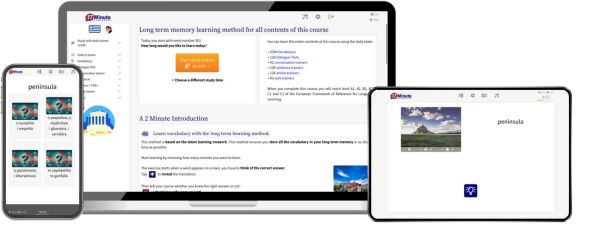
The approach here is vocabulary-first, built around spaced repetition and daily 15–20 minute sessions. The Greek course covers 1,300 words at beginner level (A1/A2), with intermediate (B1/B2, 1,800 additional words) and advanced (C1/C2, 2,100 additional words) tiers available separately or as a bundle.
What works well: the daily structure removes the “what do I study today” problem that kills most self-study attempts. The long-term memory method – where words cycle back based on whether you got them right – is genuinely effective for vocabulary retention. All audio is recorded by native speakers.
What to be aware of: the interface is functional rather than polished. If you’re coming from Duolingo expecting gamification and streaks, the aesthetic will feel dated. But the underlying method is solid, and the one-time price makes it one of the better value options in this space.
Available levels: Beginner Greek (A1/A2)* | Intermediate Greek (B1/B2)* | Advanced Greek (C1/C2)*
Mondly – Good for Daily Habit and Listening Practice
Mondly’s Greek course is one of the stronger app-based options. The conversational focus – lessons are built around realistic dialogue scenarios rather than isolated vocabulary drills – makes it useful for building listening comprehension from an early stage. The chatbot feature lets you practice short conversations without the pressure of a real interaction, which is genuinely useful for building confidence before speaking with a native speaker.
The AR and VR features are gimmicks for most learners, but the core course content is solid. At around $10/month, it works best as a supplement to a structured course rather than a standalone method. If you’re commuting or have irregular pockets of time, Mondly’s short lesson format fits well.
→ Full Mondly Greek review | Try Mondly Greek →*
Rosetta Stone – Immersion Method, No Translations
Rosetta Stone’s approach is the most methodologically distinct of the four: no translations, no grammar explanations. You learn entirely through image-word association, the way a child acquires language. For Greek specifically, this means you’re exposed to the Greek script from day one without a Latin crutch – which I consider an advantage, not a drawback.
The speech recognition is genuinely good and pushes you to work on pronunciation early. The weakness is depth: without explicit grammar instruction, you’ll eventually hit a ceiling where you can recognize patterns but can’t explain or extend them. Works best for learners who find grammar-heavy courses demotivating.
Subscription-based (~$12/month), so the cost adds up over time compared to a one-time course purchase. A three-day free trial is available.
Preply – Online Tutors for Speaking Practice
Preply connects you with individual Greek tutors for one-on-one video lessons. This is the only option on this list that gives you real-time feedback on your speaking and pronunciation from a human being. That matters – apps can’t catch the subtle errors that a good tutor will notice immediately.
Where Preply fits best: once you have A2 vocabulary and basic grammar, adding one weekly session with a tutor will accelerate your speaking progress faster than any app. Community tutors start around $10–15/hour. For Greek specifically, there’s a good pool of native speakers available.
Using Preply as your only method from scratch is expensive and inefficient – you’ll spend lesson time on basics that a course handles better. Use it as a speaking layer on top of self-study.
Find a Greek tutor on Preply →*

How Long Does It Take to Learn Greek?
This depends heavily on how much time you invest daily and what “learning Greek” means to you. Here are realistic benchmarks at 20 minutes per day:
| Level | What you can do | Time at 20 min/day | Vocabulary |
|---|---|---|---|
| A1 | Basic greetings, numbers, ordering food | 6–8 weeks | ~300 words |
| A2 | Travel conversations, simple daily interactions | 3–4 months | ~800 words |
| B1 | Everyday topics, following simple TV with subs | 6–10 months | ~1,500 words |
| B2 | Confident conversation, most TV without subs | 18–24 months | ~3,000 words |
One thing I’ve noticed across every language I’ve learned: the gap between A2 and B1 is where most people quit. The vocabulary is growing but conversations still feel clumsy. Push through that phase. It resolves faster than it feels like it will.
A Practical Learning Plan: 0 to B1 in 6 Months
This is a realistic structure at 20–25 minutes daily. Adjust the pace to your schedule, but don’t go below 15 minutes – below that threshold you lose more to forgetting than you gain from the session.
Month 1–2: Alphabet and Foundation (A1)
- Daily time: 20 minutes
- Focus: Alphabet, basic vocabulary, present tense verbs
- Primary tool: Structured course (17-minute-languages or Rosetta Stone)
- Supplement: Write 5 Greek words by hand each day – the muscle memory helps
- Milestone: Read Greek text aloud without hesitating on characters
Month 3–4: Conversation Structures (A2)
- Daily time: 20 minutes course + 5 minutes listening
- Focus: Past tense, question formation, 500+ active vocabulary
- Add: Mondly for listening practice on commutes, “Easy Greek” YouTube channel for real speech exposure
- Milestone: Have a simple 5-minute exchange with a Greek speaker
Month 5–6: Active Use (A2–B1)
- Daily time: 20 minutes course + 10 minutes media
- Focus: Future tense, subjunctive basics, expanding vocabulary to 1,000+ words
- Add: One weekly session with a Preply tutor, Greek Netflix content with Greek subtitles
- Milestone: Sustain a 10-minute conversation on a familiar topic without stopping

Free Resources Worth Using
Free resources are good for habit-building and supplementing a paid course. They are not sufficient on their own if your goal is B1 or above.
- Duolingo Greek – Best free starting point. Covers alphabet and A1 vocabulary. Useful for building a daily habit before committing to a paid course.
- Easy Greek (YouTube) – Street interviews with native speakers and full subtitles in both Greek and English. One of the best free listening resources available for any language.
- Language Transfer: Complete Greek – Free audio course focused on grammar patterns. Excellent complement to vocabulary-heavy courses.
- Tandem / HelloTalk – For finding Greek language exchange partners. Most useful from A2 onwards.
- Common Greek phrases guide – A practical reference for the most useful expressions organized by situation.
Modern Greek vs. Ancient Greek: Which One Are You Learning?
Every course on this page teaches Modern Greek (Νέα Ελληνικά) – the language spoken in Greece and Cyprus today by roughly 13 million people. This is the version you want for travel, living in Greece, connecting with Greek speakers, or watching Greek media.
Ancient Greek is a separate academic discipline, studied primarily in classical philology programs. It is not mutually intelligible with Modern Greek, though knowing one helps with the other. If you want to read Homer or Plato in the original, that’s a different learning path – and not what any of the courses above teach.
Frequently Asked Questions
Can I learn Greek on my own?
Yes. All five languages I speak were learned without formal classroom instruction. Greek is well-supported by self-study resources – good structured courses exist, native speaker tutors are accessible online, and there’s enough Greek media to keep your listening practice going indefinitely. The main risk with self-study is losing momentum around the A2 plateau. Having a weekly tutor session at that stage makes a significant difference.
How many words do I need to know to speak Greek?
Around 800–1,000 words gets you through most everyday situations. 1,500 words is comfortable for most travel and social contexts. 3,000+ words is where conversations stop feeling effortful. Focus on high-frequency vocabulary first – the most common 1,000 Greek words cover roughly 85% of everyday speech.
Is Duolingo enough to learn Greek?
For A1 and habit-building, Duolingo is fine. Above A1, it runs out of depth. Grammar explanations are thin, vocabulary coverage is limited, and there’s no systematic way to build past that point. Use it as a warm-up tool, not a complete solution.
What’s the difference between Mondly and a structured course?
Mondly is app-first – short sessions, gamified, conversation-focused. A structured course like 17-minute-languages is more systematic about vocabulary coverage and grammar progression. They solve different problems. Mondly keeps you engaged on busy days; a structured course builds the foundation. Using both is not redundant.
Do I need to learn the Greek alphabet before starting a course?
A good course integrates alphabet training from the beginning. You don’t need to complete the alphabet before starting – but you shouldn’t use a course that skips it entirely or relies on transliteration. Learning the characters in parallel with your first vocabulary is the most efficient approach.
Is Greek worth learning?
That depends entirely on your reasons. For someone with Greek heritage, a Greek partner, or plans to live in Greece – obviously yes. For someone who loves the history, literature, or culture – also yes. As a purely pragmatic language investment for career purposes, Greek has a limited geographic footprint. But language learning has never been purely pragmatic. The people I know who learned Greek all say the same thing: the culture and the people made it worth it.
Where to Go From Here
If you’re ready to start: pick one course and commit to 20 minutes a day for 30 days before evaluating. The biggest mistake most learners make is switching methods too early. Every method feels insufficient after 2–3 weeks because that’s when the initial novelty wears off and the real work begins. Stay the course.
Once you have the basics, explore the rest of the Greek content on this site:
- Greek phrases – the most useful expressions for real situations
- Mondly Greek – full review
- How to learn vocabulary that actually sticks
- Staying motivated through the difficult middle stage
For a broader look at what research says about adult language acquisition, the Cambridge English research hub has accessible summaries worth reading.
About the Author
Sven Mancini is a published language learning author and self-taught polyglot. He has learned Norwegian, Danish, Swedish, French, and Spanish as an adult – all through self-study. His four vocabulary guides document the systematic methods he developed over two decades. He started this site in 2018 to share honest, experience-based reviews of language courses and apps.
* Affiliate disclosure: Some links on this page are affiliate links. If you purchase through them, we earn a small commission at no extra cost to you. Recommendations are based on personal testing and genuine assessment – not commission rates.